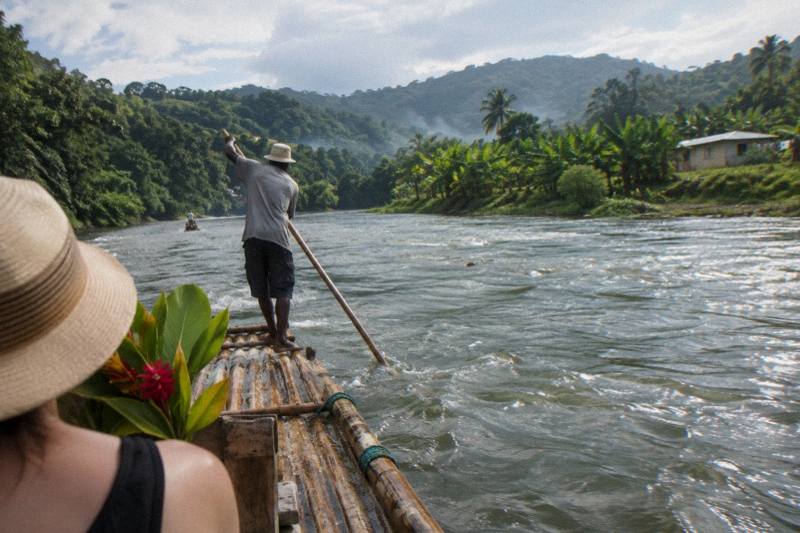
Rio Grande Rafting From Port Antonio: The Long Float
The Rio Grande in Portland is the long bamboo raft float in Jamaica's east, a two to three hour river journey from Berrydale to Rafters' Rest that began as a banana route and became a leisure trip through Errol Flynn's Port Antonio.
Short answer
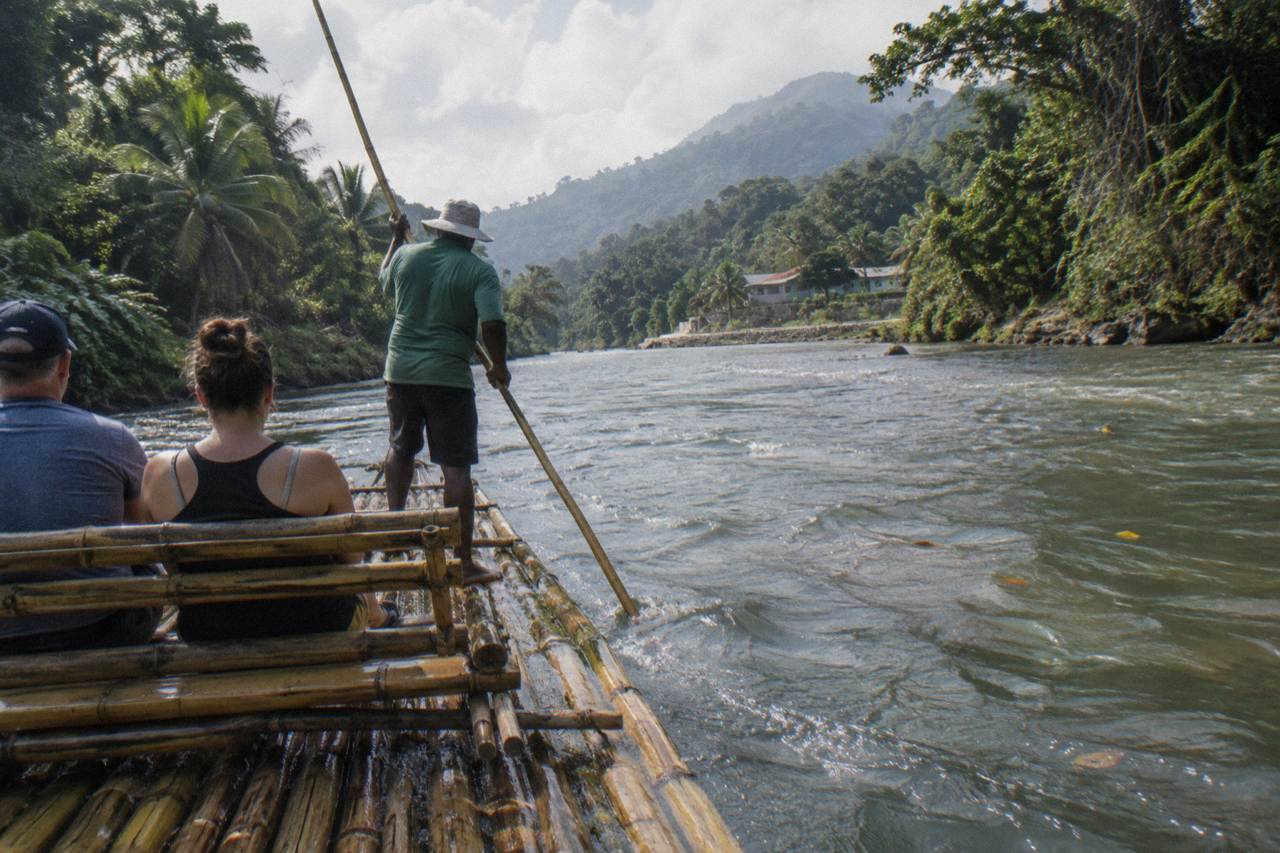
Rio Grande rafting runs from Berrydale in the Rio Grande Valley to Rafters' Rest at St. Margaret's Bay, a roughly 6 mile route that typically takes 2 to 3 hours on a 30 foot bamboo raft carrying two adults, one small child and a captain. Bookable tours start from $220 per person for a private Portland raft and jerk trip.
The Rio Grande is the river people mean when they talk about the long float. Where the Martha Brae run covers 3 miles in about an hour and a quarter, and the Lethe rides on the Great River usually run 60 to 90 minutes, the Rio Grande trip from Berrydale to Rafters' Rest at St. Margaret's Bay covers about 6 miles and typically fills 2 to 3 hours on the water. It is the trip that gave Portland its rafting identity, worked by about 80 raft captains who pole bamboo rafts that once carried bananas down this same valley. For travelers staying in Port Antonio, it is the signature excursion; for anyone based in Montego Bay or Negril, it is a deliberate day trip east. This guide covers the route, the length, the cost, the drive times and the bookable tours, including how the river's raft fleet was rebuilt after Hurricane Melissa. If you're still picturing the route on a map, our guide to where the Rio Grande sits on Jamaica's east coast lays out the river's path and the roads that reach it.
What Is Rio Grande Rafting In Jamaica?
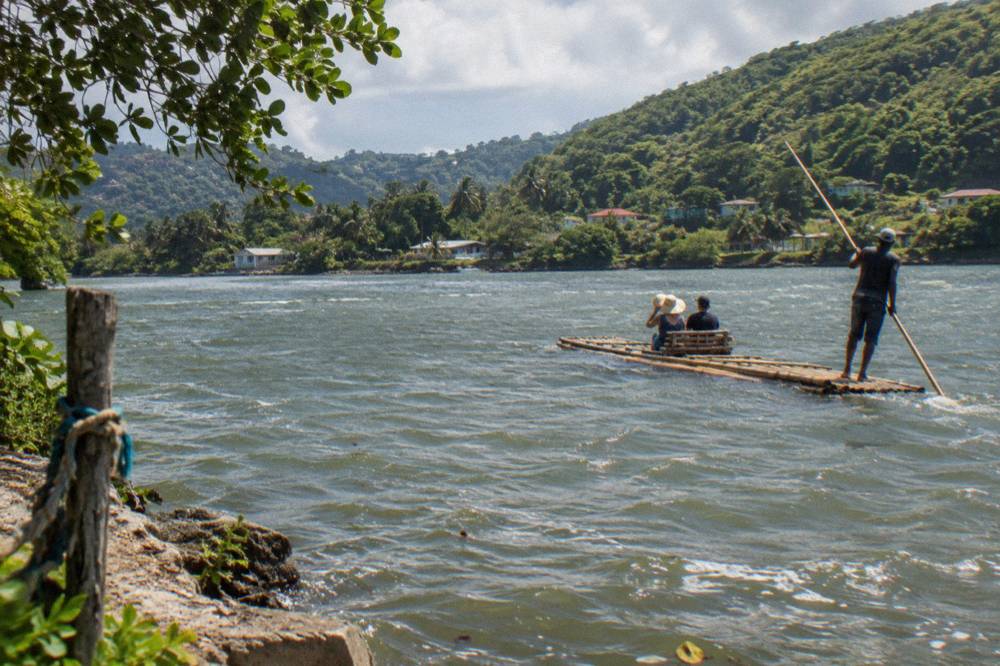
Rio Grande rafting is a poled bamboo raft trip on the Rio Grande river in Portland parish, on Jamaica's northeast coast, running from the Berrydale put-in in the Rio Grande Valley down to Rafters' Rest at St. Margaret's Bay. The route is about 6 miles long and a typical trip lasts 2 to 3 hours. One raft carries 2 adults and 1 small child plus the captain, which makes it a private, slow float rather than a group paddle.
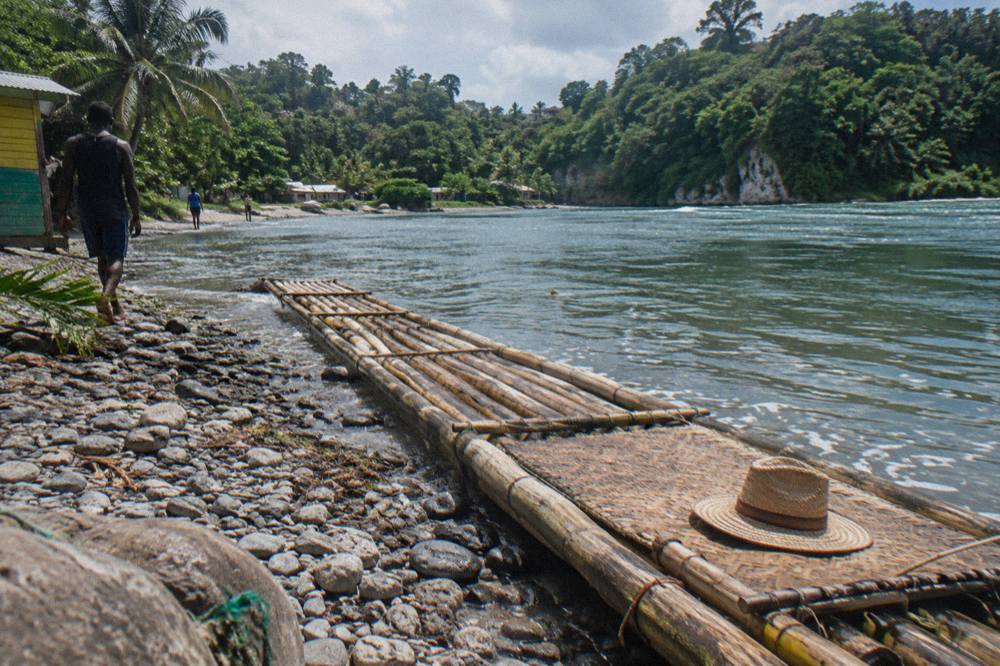
The rafts themselves are the story. Bamboo rafts first worked this river as freight craft, moving bananas and produce from valley farms toward the coast, and the leisure trip grew out of that working route. The Hollywood actor Errol Flynn is part of the legend: he arrived in Port Antonio in 1946 when his yacht Zaca washed ashore, and he is credited with popularising rafting on the Rio Grande as a leisure pastime. Nobody claims he invented it; the banana rafts were on the water long before him. The distinction matters because the trip still feels like working river life, a captain with a pole, a raft about 30 feet long, and a valley of small farms and forest on both banks. For the full backstory of how a shipwrecked movie star and a banana route turned into Jamaica's signature float, read our history of Errol Flynn and the Rio Grande rafts.
Rafting rates on the Rio Grande are set by the Tourism Product Development Company, TPDCo, and the captains who run the route are licensed raftsmen, around 80 of them according to reporting in the Jamaica Gleaner. Use a licensed operator, and if you book one of the packaged tours covered here, the rafting fee is part of what you pay rather than something settled river-side. For readers weighing Portland against the north coast rivers, our Portland things to do overview places the raft trip among the other reasons to make the drive east.
A quick word on what the Rio Grande is not. It is not whitewater rafting, there are no paddles, no helmets and no rapids to speak of, and the river moves at a pace set mostly by rainfall upstream. It is also not the same product as the Great River massage rafts near Montego Bay, where the limestone foot massage is the draw. On the Rio Grande the draw is length and scenery: the valley between Berrydale and the sea is the reason people book it.
Where Does The Rio Grande Rafting Trip Start And Finish?
The standard Rio Grande rafting route starts at Berrydale, a put-in point in the Rio Grande Valley about 15 to 25 minutes inland from Port Antonio, and finishes at Rafters' Rest at St. Margaret's Bay on the coast. The route is about 6 miles, roughly 10 kilometers, and the endpoint is a riverside spot where captains land the rafts and transport meets you. Getting back to Port Antonio from Rafters' Rest takes about 15 to 25 minutes by road.
Berrydale is the practical anchor for planning. If you drive yourself or take a taxi, you head inland from Port Antonio into the valley, and the put-in is where the captains stage the rafts. Packaged tours handle this differently: they collect you at your hotel or an agreed meeting point, drive you to the start, and meet you at the finish. The Port Antonio rafting guide walks through the pickup options in detail for each bookable tour, including which ones include lunch.
The journey downstream is the whole point. What any given tour includes along the way varies by listing, so read the inclusions before you book rather than assuming. The one listed Rio Grande tour covered here includes lunch and bottled water in its inclusions, and the Portland combo tour includes a quarter jerk chicken with a side order per guest.
The Port Antonio raft tour is the straightforward float with lunch included. The Portland combo pairs the raft with the Boston Jerk Centre.
How Long Does A Rio Grande Bamboo Raft Trip Take?
A typical Rio Grande raft trip lasts 2 to 3 hours on the water. That is the river time only. The packaged tour listed from Port Antonio states a total duration of 2 hours 30 minutes for the whole experience, while the Portland raft and jerk combo states 4 hours total because it adds the jerk stop and the drives. Plan the day, not the float. While you sketch out the rest of your day, the guide to what Port Antonio is famous for covers the Blue Lagoon, Boston Bay jerk, and the other quiet sights most cruise crowds miss.
The 2 to 3 hour figure is the standard river time reported for the Berrydale to Rafters' Rest route, and it moves with the state of the river: after heavy rain the current is quicker, in the dry months the captains pole more. Compare that with the other rivers and the difference is stark. The Martha Brae ride covers 3 miles of a 20 mile river in about 1 hour 15 minutes. Lethe rides on the Great River usually run 60 to 90 minutes. The White River trip near Ocho Rios lasts about 45 minutes. If the question is how much river you get for the drive, the Rio Grande answers it, which is the whole argument in our Martha Brae versus Rio Grande comparison.
| River | Nearest base | Typical time on the water | Route length |
|---|---|---|---|
| Rio Grande (Portland) | Port Antonio | 2 to 3 hours | About 6 miles, Berrydale to Rafters' Rest |
| Martha Brae (Trelawny) | Falmouth, Montego Bay | 1 hour 15 minutes | 3 miles of a 20 mile river |
| Lethe, Great River (St. James) | Montego Bay | 60 to 90 minutes | Not published by the operator |
| White River (St. Ann) | Ocho Rios | 45 minutes | Not published by the operator |
One caution on durations: a listing's stated duration is the listing's own total, which can include the drive to the put-in, the float, and the return. A 4 hour Portland combo is not 4 hours on the water, and the 2 hour 30 minute Port Antonio raft tour is not two and a half hours of drifting. The river time figures in the table above come from operator and reporting sources for the river itself, not from any single package.

What Does Rio Grande Rafting Cost?
Bookable Portland tours listed here run from $220 per person for the private raft and Boston Jerk Centre combo to $300 per person for the private Port Antonio raft tour with lunch and bottled water included. The river-side rate set by TPDCo was set in 2023 and may not reflect what you are asked to pay now, so treat the tour listings as the firm numbers and confirm river-side fees before you go.
The per-person prices above come from the live listings. The Portland combo tour, from $220 per person, is a private tour that includes the rafting fees, private transport, refreshments and snacks on board, and a quarter jerk chicken with a side order per guest. The Port Antonio raft tour, from $300 per person, is likewise private, includes lunch, bottled water, transportation and a guide, and states pickup in Port Antonio with the exact meeting point confirmed on the booking page. Both list free cancellation. Neither requires you to settle anything at the riverbank, which is the quiet advantage of a package over arriving independently.
For independent travelers, the history of the river-side rate is worth knowing. TPDCo set the official rafting rates in September 2023, raising the long trip to J$12,000 per raft from J$7,300 and the short trip to J$10,000 from J$6,000, as reported by the Gleaner at the time. Those figures are per raft, not per person, and they were set in 2023; no official source publishes a confirmed current rate, so do not budget from them. If you plan to pay at Berrydale, ask the operator or your hotel what the current rate is before you commit.
Does the price difference between the two Portland tours make sense? On paper the $80 gap buys you the jerk stop and the longer 4 hour day in the combo, versus the tighter 2 hour 30 minute raft-only experience. If food is part of why you came to Portland, the combo is the better spend; if your day is short, the straight raft tour from the Rio Grande tour page keeps things simple.
Can You Reach The Rio Grande From Montego Bay, Ocho Rios Or Kingston In One Day?
Yes, but the drives are long. From Port Antonio the valley is 15 to 25 minutes away; from Ocho Rios the drive to the Port Antonio area runs 2 to 2.5 hours; from Kingston 2.5 to 3.5 hours; and from Montego Bay 4 to 4.5 hours each way. That makes the Rio Grande a natural trip from Port Antonio and a very full day from anywhere else.
The arithmetic is the honest starting point. A couple based in Montego Bay faces 8 to 9 hours of driving wrapped around a 2 to 3 hour float, which is why most Montego Bay visitors raft the Great River at Lethe or the Martha Brae instead, both of which are under an hour away. The Lethe runs are covered in our rafting from Montego Bay guide. If your heart is set on the Rio Grande and you are staying west, the realistic play is to overnight in Port Antonio, raft in the morning, and drive back the next day. Portland's rainfall also runs well above Montego Bay's in every month, so a two night stay gives you a rain window.
| From | Drive to the Rio Grande area | Realistic same-day raft trip? |
|---|---|---|
| Port Antonio | 15 to 25 minutes | Yes, comfortably |
| Ocho Rios | 2 to 2.5 hours | Possible, a full day |
| Kingston | 2.5 to 3.5 hours | Possible, a full day |
| Montego Bay | 4 to 4.5 hours | Not recommended; overnight instead |
| Negril | Longer than Montego Bay | Overnight required |
For cruise passengers the answer is firmer: the only cruise-adjacent scenario that works is a Port Antonio call, and no verified schedule or all-aboard time supports promising the trip fits any particular ship. Check your ship's all-aboard time against the drive figures above before you consider it. The two Portland tours listed here depart by arrangement, with pickup in Port Antonio for the raft tour and a start point agreed with the operator for the combo, so neither is positioned as a cruise-ship product.
How Does The Rio Grande Compare With Martha Brae And The Other Rivers?
The Rio Grande offers the longest float, about 6 miles and 2 to 3 hours, against 1 hour 15 minutes on the Martha Brae and 45 minutes on the White River, but it is the hardest to reach from the main resort strips. Martha Brae is a 20 mile river near Falmouth with a purpose-built rafting operation; the Rio Grande is a working valley route. Choose by base and by how much river you want.
The rivers genuinely suit different travelers. Martha Brae, run by River Raft Limited since 1985 under an attraction that began in the 1970s, is the polished product: an operator-stated 3 mile ride on a 20 mile river, open daily 9 am to 4 pm, about 30 minutes from Montego Bay, with bookable tours including the featured bus-transportation listing at from $146.16 per person, rated 5.0 from 582 reviews. Local legend ties that river to a woman named Martha Brae and hidden Spanish-era gold.
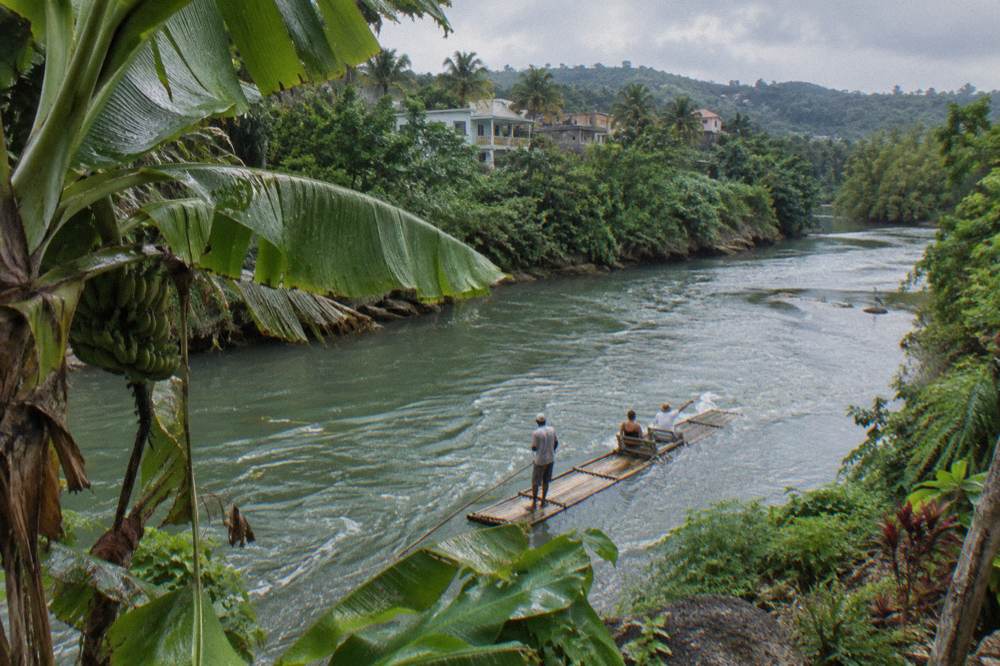
The Rio Grande trades polish for scale. There is no equivalent of the Martha Brae rafting village on the northeast coast; there is a valley, a put-in at Berrydale, a landing at Rafters' Rest, and about 80 captains. Lethe, on the Great River, splits the difference for Montego Bay visitors: 60 to 90 minute rides, usually on private rafts, with the limestone foot massage that has become the signature of that river, covered in full in our limestone massage guide. The White River near Ocho Rios is the short option, 45 minutes, minutes from the cruise pier. If you want the full comparison across all four, the rivers compared guide breaks down price, pickup and pace side by side.
| River | Best for | Signature | Rafter's practical note |
|---|---|---|---|
| Rio Grande | The long float, Portland stays | 2 to 3 hours, valley scenery | Overnight in Port Antonio if coming from the west |
| Martha Brae | First-time rafters near Falmouth | Classic 3 mile run | Book transport-included or check the raft fee basis |
| Lethe, Great River | Montego Bay visitors, couples | Limestone foot massage on the raft | Rides 60 to 90 minutes, private rafts common |
| White River | Ocho Rios and cruise calls | Short 45 minute float near the pier | Check the listing for pickup details |
What Happened To The Rio Grande Rafts In Hurricane Melissa?
Hurricane Melissa made landfall on Jamaica on 28 October 2025 as a Category 5 storm, and Rio Grande raft captains reported losing well over 100 rafts when the river overflowed, close to 140 by the Gleaner's count, which hit the livelihoods of roughly 80 captains. Portland's attractions, including Rio Grande rafting, were described as continuing to operate in late November 2025, and the fleet has been rebuilt with new rafts since.
The reporting is specific and worth reading in the sources. The Gleaner reported on 30 October 2025 that nearly 140 bamboo rafts were swept away or destroyed by floodwaters, and that many raftsmen had absorbed repeated losses in recent years. Unlike the Martha Brae operation, which lost no rafts after it scaled down before the storm, the Rio Grande fleet is built and kept by the captains themselves, so the loss landed directly on the people who pole the trips. Rebuilding those rafts is heavy work with fresh bamboo, and within weeks the eastern parish was being positioned to help fill the tourism gap left by damage in the west, as the Gleaner reported on 22 November 2025.
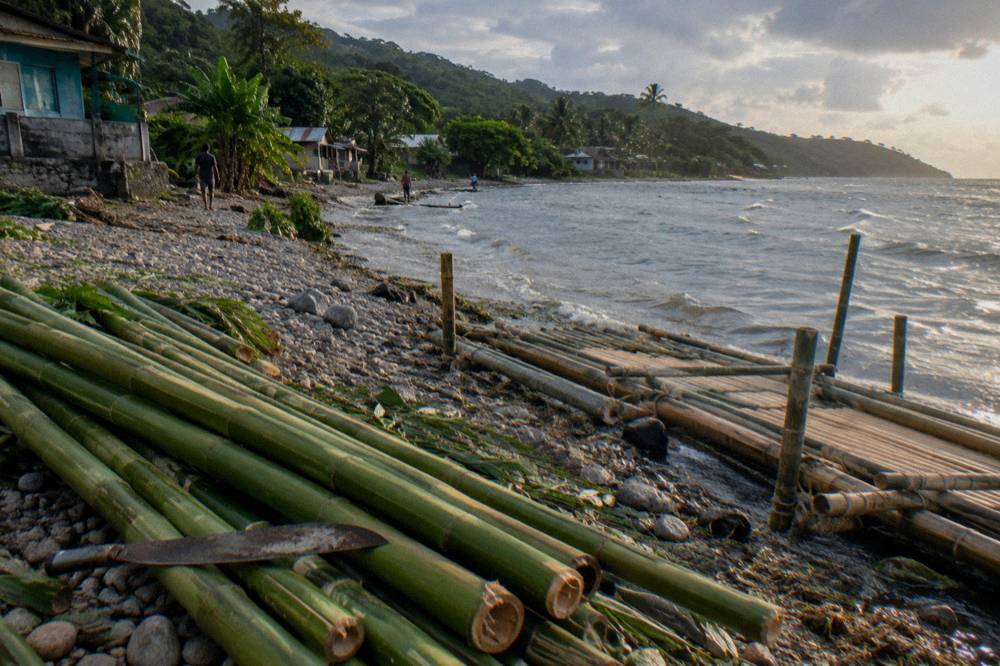
For a traveler reading this in planning mode, the practical takeaway is simple: the river was reported operating again after the storm, but no official notice confirms real-time conditions on any given day. Confirm on the booking page before you drive east, the same advice that applies to every river here. Portland itself fared comparatively well; Port Antonio was in the first wave of the post-Melissa port reopening sequence and the Tourism Minister described it as hardly touched.
What Should You Bring On A Rio Grande Raft Trip?
Bring sun protection, a hat, water, cash for gratuities, because the raft is open and the float runs 2 to 3 hours. Wear clothing that can dry, keep phones and cameras in a dry bag, and check the listing for whether food and drinks are included, since the two Portland tours differ: the raft tour includes lunch and bottled water, the combo includes jerk chicken and on-board refreshments.
Two to three hours on an open raft in tropical sun is longer than most people expect. The valley sections give shade, but the wide bends do not, and the UV off the water is real. Dry bags matter more here than on the shorter rivers simply because there is more river for a splash or a squall to find you. Our what-to-wear guide covers the clothing question in detail, including footwear that survives a wet raft deck.
Gratuities are not included on the Portland raft tour's inclusions, and the combo lists gratuities under exclusions, so plan cash for your captain if the trip earns it; our guide to tipping raft captains explains the norms without inventing percentages. If you are booking the raft-only Port Antonio tour, note that its exclusions include pickup and drop-off outside the parish of Portland, so anything beyond Port Antonio needs to be arranged and confirmed on the listing first.
Should You Book The Rio Grande Or A Portland Combo Tour?
Book the straight raft tour from $300 per person if the float itself is the goal and you want lunch, a guide and Port Antonio pickup in one package; book the raft and Boston Jerk Centre combo from $220 per person if you want the longer 4 hour day that pairs the river with Portland's food culture. Both are private, both list free cancellation, and both cover the rafting fees so nothing is settled at the riverbank.
The choice is genuinely about the shape of the day. The raft-only tour, rated too new for a star claim with a single review so far, keeps the experience tight at 2 hours 30 minutes total. The combo, with 10 reviews, spends 4 hours adding the jerk stop, and jerk from the Boston Bay area is one of the foods Portland is known for; the listing includes a quarter jerk chicken with a side per guest. Neither is a shared tour, so your raft is your own either way.
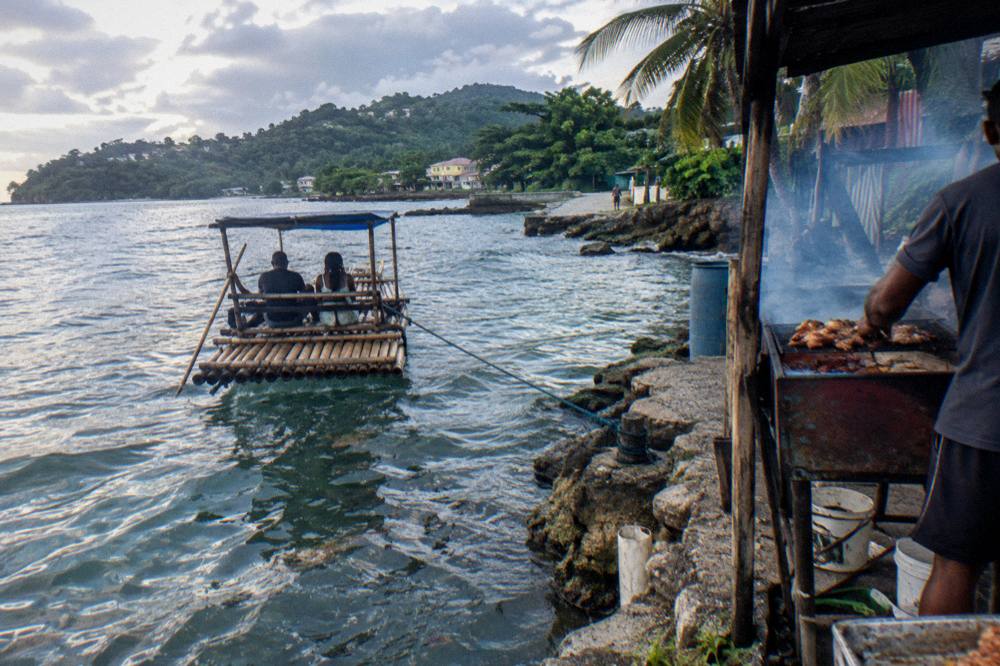
If Portland is a detour on a north coast trip rather than your base, be honest about whether the Rio Grande is the right river at all. The featured Martha Brae listing with bus transportation, from $146.16 per person and rated 5.0 from 582 reviews, delivers the classic Jamaican raft morning from Montego Bay hotels with the raft fee and transfers inside the price, in 3 to 4 hours total.
Whichever you choose, the booking mechanics are the same: free cancellation is listed on both Portland tours, prices are per person in USD as shown, and the live listing confirms pickup points and times.
Common Questions About Rio Grande Rafting
Where Does The Rio Grande Rafting Trip Start And Finish?
The standard route starts at Berrydale in the Rio Grande Valley, about 15 to 25 minutes inland from Port Antonio, and finishes at Rafters' Rest at St. Margaret's Bay, about 15 to 25 minutes by road back to Port Antonio.
How Long Does Rio Grande Rafting Take?
The river trip itself typically lasts 2 to 3 hours over about 6 miles. Packaged tours state their own totals: 2 hours 30 minutes for the Port Antonio raft tour and 4 hours for the raft and Boston Jerk Centre combo.
How Much Does Rio Grande Rafting Cost?
Bookable tours listed here run from $220 per person for the private raft and jerk combo to $300 per person for the private Port Antonio raft tour with lunch included. TPDCo's official per-raft river-side rates were set in 2023 and no confirmed current figure is published, so confirm before paying at the river.
Can You Do The Rio Grande As A Day Trip From Montego Bay?
The drive from Montego Bay runs 4 to 4.5 hours each way, which makes a same-day trip impractical. Overnight in Port Antonio instead; from Ocho Rios the 2 to 2.5 hour drive makes a full day possible.
How Many People Fit On A Rio Grande Bamboo Raft?
One raft carries 2 adults and 1 small child plus the captain, the same configuration used on the Martha Brae.
Is The Rio Grande Rafting Open After Hurricane Melissa?
Rio Grande rafting was reported continuing to operate in late November 2025 after the storm, and the fleet was rebuilt after captains reported losing well over 100 rafts. Confirm current conditions on the live booking page before you travel.